Mélissa Colin
AI Student · World Models
What drives me is rethinking the foundations of AI: architectures inspired by living systems, able to build their own "model of the world" and more frugal than Transformers, whatever the application domain. Right now, I'm a Mitacs Globalink research intern at the University of Alberta's Vision & Learning Lab, working on physics-grounded 3D motion generation. My dream: to one day become a Research Scientist.
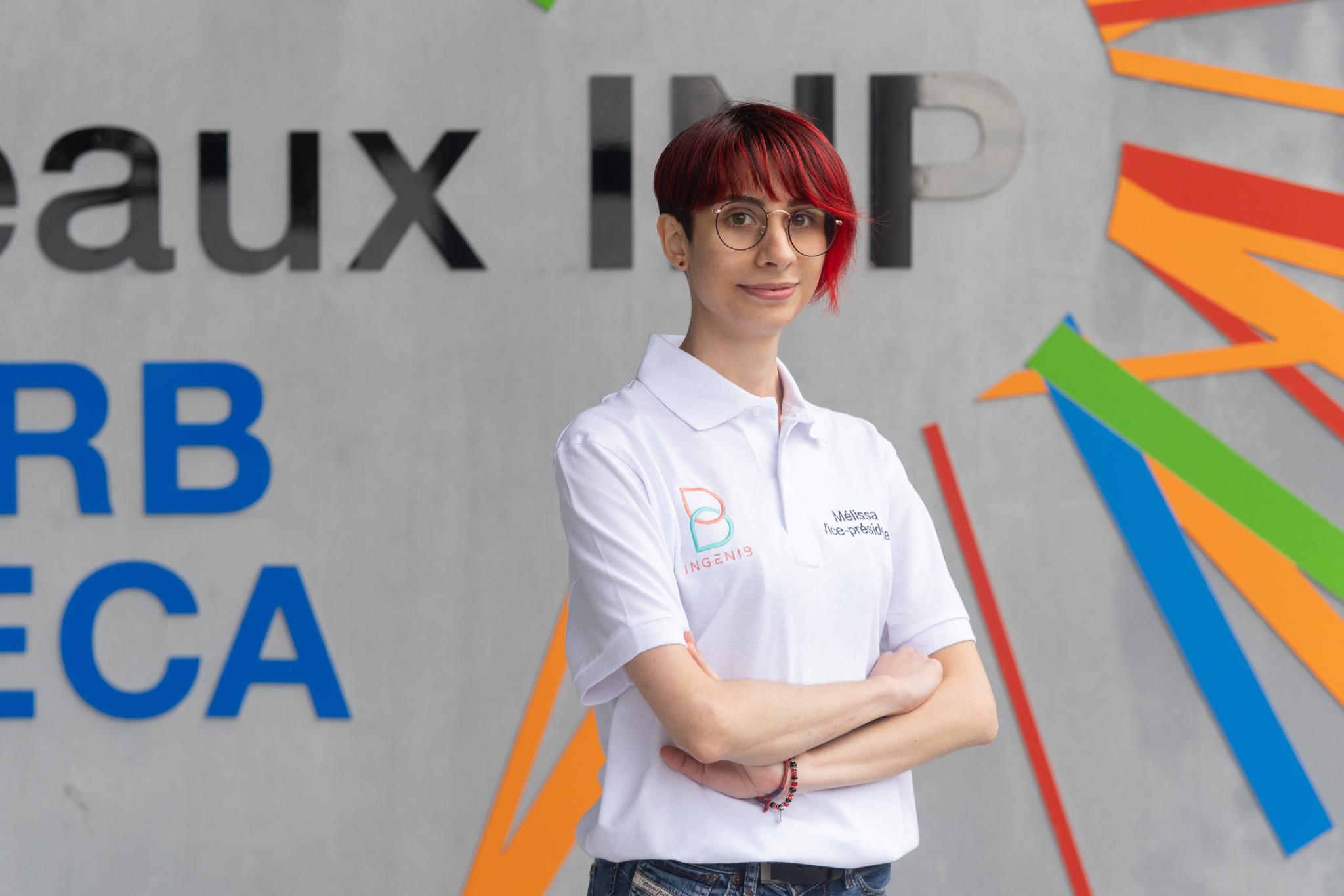
23 years old
Engineering Student
ENSEIRB-MATMECA
What drives me
Designing the model architectures of tomorrow.
My north star: rethinking the foundations of AI, toward more general, more frugal, life-inspired models, whatever the application domain.
World Models
Models that learn an internal representation of the world to anticipate, reason and act.
Bio-inspired architectures
Drawing from living systems for more efficient, robust and generalizable models.
Post-Transformer efficiency
Rethinking attention and compute for models that are frugal in energy and data.
Mitacs Globalink research intern at the University of Alberta's Vision & Learning Lab, on physics-grounded 3D motion generation.
Research Scientist
About Me
I'm an engineering student at ENSEIRB-MATMECA, on the engineer-doctor track. What drives me is rethinking model architectures: making them more inspired by living systems, able to build their own "model of the world" and more efficient than Transformers. Right now, I'm a Mitacs Globalink research intern at the University of Alberta's Vision & Learning Lab, working on physics-grounded 3D motion generation. And my longer-term goal is to become a Research Scientist at Google.
From a village in Gironde to AI research
I grew up in a rural village in Gironde, in a working-class family. As a kid, I was told I wasn't made for studying, but for working. I taught myself to code: Scratch at 12, Python at 13, then a technical high school. What captivated me, very quickly, was algorithms and the way a machine can learn, far more than websites or games.
The spark came during an internship at Cali Intelligences, a computer-vision startup. I threw myself into it with a conviction that never left me: rather than stacking more layers, I wanted to contribute to the very foundations of AI by rethinking model architectures. I moved up one step at a time, ranking first at each stage, until I was admitted to ENSEIRB-MATMECA on merit and ranked 3rd out of 93, then earned a Mitacs Globalink scholarship to do research at the University of Alberta.
Why I do this
At heart, my drive isn't only scientific. I want to prove it's possible: so that another girl from a modest background can look at me and think, "if she could, then so can I." Science is the tool, opening the way is the goal. And I hold one red line: never to put my work in the service of surveillance or military uses. My motto is a line from Stephen Hawking: "Intelligence is the ability to adapt to change."
Expertise & Skills
A technical and human foundation built around what really interests me: model architectures, world models and bio-inspired systems. Computer vision and explainable AI, meanwhile, remain tools.
Model-architecture design
World models, bio-inspired models, post-Transformer efficiency, attention mechanisms, diffusion models, fine-tuning (LoRA/PEFT)
Research methodology
Empirical studies, ablations, metrics and reproducibility, critical reading of the literature, scientific writing
Mathematical foundations
Linear algebra, optimization, probability, information theory
Deep Learning & Vision
CNNs, ViTs, Transformers, diffusion models, pose estimation, OpenCV
Languages & frameworks
Python, PyTorch, NumPy, Pandas, scikit-learn, C, SQL
MLOps & scaling
Docker, Kubernetes, Kubeflow, optimized training pipelines
AI ethics & reliability
Robustness, algorithmic bias, GDPR and the AI Act
Interpersonal skills
Curiosity, rigor, autonomy, leadership, teamwork
Languages
French (native), English (fluent, TOEIC 840), Chinese (basics)
Notable Achievements
- • Mitacs Globalink research excellence scholarship: research internship at the University of Alberta's Vision & Learning Lab, on physics-grounded 3D motion generation
- • My first peer-reviewed paper, published at age 20: an empirical study of ViT and CNN architectures, presented at PFIA 2024
- • Ranked among the top 3 (3/93) of ENSEIRB-MATMECA's computer-science track, and winner of a national innovation competition with EcoSort
- • Vice-president of ENSEIRB-MATMECA's Ingenib recruitment forum (team of 22)